A few nights ago, I was sitting in a wooden chair in the corner of the living room. This wooden chair has a sheepskin draped over it and a lamp sitting behind it, and is one of the coziest spots in our home. My wife and kids were laying on the floor in front of the fireplace reading books. I had The Iliad open in my lap, but my mind was somewhere else. I was thinking about AI and job replacements and system implementation, and I was wrestling with the fact that AI, as it stands now, is better than me at a lot of things. It's better at remembering, better at connecting dots between facts that I give it, better at referencing scripture actually, better at a lot of stuff. But there's one thing that AI can't compete on: human interactions.
Before I sat down in this favorite chair of mine, I was standing in front of my book shelf trying to decide which book I would take with me to the chair in the corner. My first instinct is to reach for one of the books I am reading for education: Capitalism and Freedom or The Wealth of Nations? But I hesitated. So much is changing in the way value is created. And so much will change in the near future. Made me question whether these books were even worth reading. What are these old books going to have to do with economics of tomorrow? I don't know.
So I moved past those two on the right and kept going down. Soon there was a collection of documents from the founding of America. Seems interesting but it's still in its cellophane wrapper and I feel like opening it is kind of a big commitment so I moved past that as well.
If you're enjoying this, I'd love to keep you in the loop. I send the occasional note when I publish something new.
At the very end of the shelf sat The Odyssey and The Iliad, two old books that have stood the test of time. The Bible also stood out to me. It has withstood many tests, more than any other on my shelf I would say. Not only is it the written Word of God but it's also a historical text that was valuable long before it was written on paper — first as an oral tradition passed down through generations. And now, millions of people have multiple copies in different translations sitting on their shelves in their house, or open on their kitchen table in the morning. The Bible tells a story of history, and of Jesus, which is no small thing. It also tells the story of creation. The Fall, Humans Wrestling with Sin, and it has whole books of wise sayings and songs of praise to the Lord. Often I turn to Proverbs when I'm not sure what to read. Much of the "wisdom" of our current age seems to just be regurgitated Proverbs or passages from other old books.
Books like these have seen the rise and fall of new technologies and their replacement, the rise of great men and the fall of those same men, and the whole time they were a foundation for their readers. When the Industrial Revolution happened and many people lost their jobs or changed their jobs, these books were a foothold. That's kind of reassuring. This train of thought was spiraling so fast I grabbed the closest notebook to me and a pen and started scribbling my thoughts down just to get them out of my head.
Thoughts get disentangled one of two ways:
- Through your tongue and speaking about your thoughts
- Through your fingertips and writing about them
This moment reinforced my desire to read the classics. The best books ever written. Books that have lasted thousands of years and are still read today.
I think these books are valuable because they have foundational truths and ideas that humans have been wrestling with for our whole existence. Going to the oldest version of that thought that we can get our hands on now lets us go all the way up the genealogy of ideas and enjoy the same texts that our favorite authors got their mental models from (seen below).
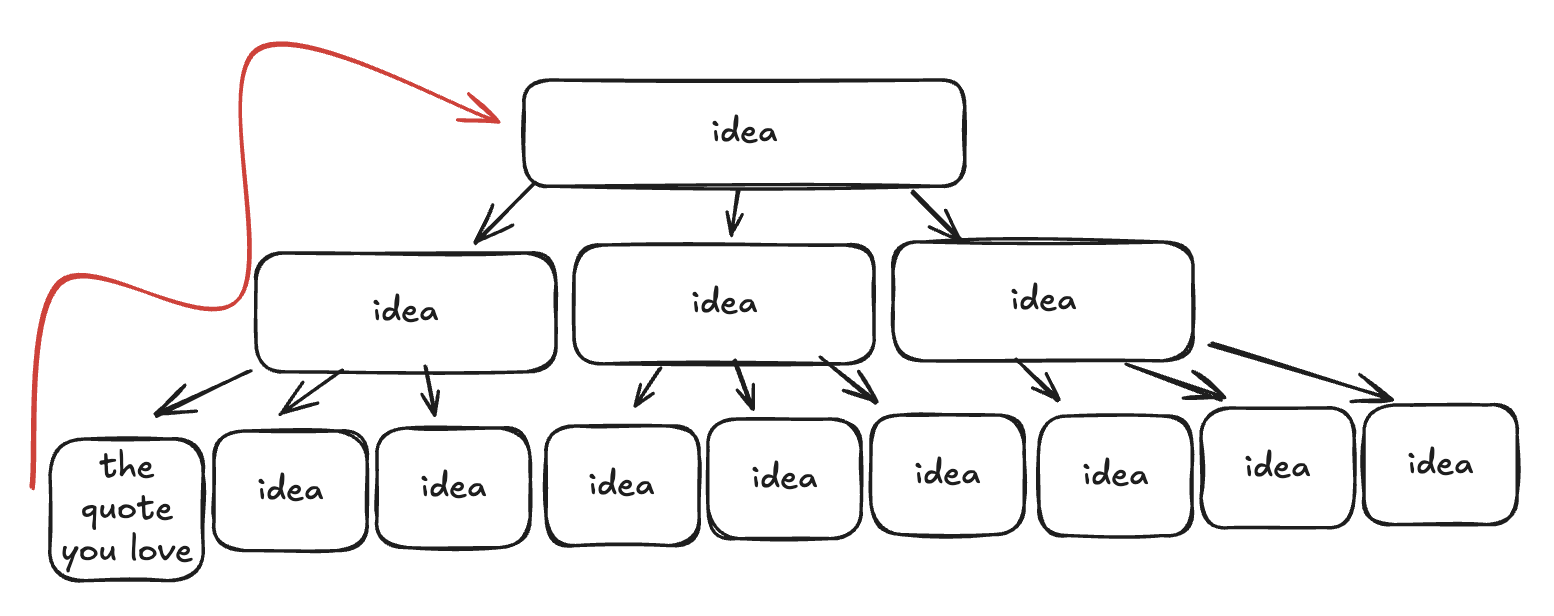
In my experience reading these "foundational" texts gives you that base to start having new ideas of your own and to start connecting things that in our modern world seem completely disconnected, but if you go back far enough in the genealogy, you realize that the quote you love and that idea on the far right are actually all connected in some way.
AI can do this, too. It can show you the connections between that quote you love and another idea that resonates with you. But it can't change the way you think, the way that you process things. Having these texts absorbed in my mind in some small part, I think makes me draw new connections in my own life and my experience, and my values, and in my emotions. And I think those human traits and skills are going to become more and more valuable in the coming years.
So instead of picking up The Wealth of Nations and my pencil, I sat down with a copy of The Iliad. Reclined in my chair, I opened it up and didn't even finish a page. I started talking to my wife and my daughter watching my son climb around on both of them. And just lived in that moment.
There are certain things that are intrinsically valuable because of the way that we as humans are created. Moments, and people, and pieces of creation that are worth pausing and pushing the rest of the world out of your mind for.
I'm looking out the window right now, sitting in my office in the woods, and a few of those deeply valuable things point themselves out to me. Nature being one of them. The 300-year-old oak tree that presses up against the deck of the treehouse in a strong windstorm. Or the native grasses, slightly swaying in the wind. The birds fluttering around in the trees.
These are all things that forever have pointed us humans to a greater reality. The reality that there is something deeper and more meaningful than innovation and efficiency or the wonders of our day.
I wrote about the blessing of having a spouse in my essay on trust, but truly, being married and living life with another imperfect human being is a more human experience than most others. Seeing your child be born. Watching them grow. Watching that child play with their sibling. These things matter. Seeing those two children run or crawl around in the woods. The same woods where you ran and crawled around with your brothers, perhaps. That's a blessing that, however aware of it I am, I sometimes take for granted.
That moment turned from one of wrestling with my thoughts about AI to enjoying a little piece of an old book and, ultimately, a moment in time with my family. If you're wrestling with the same things, whether it be AI, the economy, social injustices of the day, or perhaps something else that weighs on your mind that I haven't thought of in this moment. I'd encourage you to take a walk outside; it's beautiful today. Find some place where you can't hear cars. Nebraska wildlife areas that are open to the public and are farther away from town. These are great places to get away if you live here too.
I would also like to encourage you with another idea that echoes through time. A thousand years ago, man was inventing technology. A thousand years from now, man is also going to be inventing technology.
A technology can be used for good or evil. Technology doesn't make good men good or bad men bad. It can amplify the impact of any person who chooses to wield it.
Don't be afraid of AI; ask it a question, go down a rabbit hole. But don't make that conversation the end of your exploration. Go find those foundational texts that have survived for thousands of years — books where people are wrestling through the same thoughts you are now. Read some old autobiographies (my favorite from a couple years ago was Benjamin Franklin's biography). Read some old fiction (I just read The Count of Monte Cristo; it was amazing). Read your Bible. Spend time with your friends and family. Have a walk in the woods. Talk about things you're not comfortable talking about, and do some trust building with a friend of yours. Let your mind explore these things and mull over them. Make connections you otherwise wouldn't make. AI is really cool, but you have to know what to ask it — and without a broad understanding of what exists and a deep understanding of what's possible, you don't even know the questions to ask.
I hope you guys had an amazing week. I'm going to continue my little video series where I sit in the woods and read something out of one of the books currently in my reading rotation. If there's something that interests you about anything I mentioned in this little rant, let me know. I'd love to talk to you about it. Maybe more in the next blog post, or perhaps in person. Thanks for taking the time to read this. I appreciate you.
Related Notes
Planning as a Tool to Steward Well
My mind lives in the future. I have intentionally tried to make decisions that will have a positive impact on my personal mission which largely revolves around healthy family relationships and...
On Trust
Trust is accumulated slowly like drops in a bucket and depleted quickly through either misunderstanding or betrayal.
2026 Introduction
I grew up on a small family farm south of Lincoln, Nebraska, always interested in business and fatherhood. From opening my first coffee shop at 19 to becoming a fractional CFO, my journey has been shaped by failure, learning, and a deep desire to build something lasting. Today, I help people steward their resources well and create fulfilling, sustainable places through Finance Catalyst, Leadership Catalyst, and Carlson Projects.